PRC-DeSoto Fuel Tank Sealants Available on GSA Advantage
Perhaps no location on the entire aircraft is more important for a good seal than the fuel tanks. Fuel tanks are highly complex devices on an aircraft that are built integrally into the aircraft, rather than being separate tanks like those on other machinery. Fuel containment on aircraft requires significant work and maintenance, along with specialized sealants to address the constant contractions and expansions that are a standard part of the duty day.
Because of these working conditions, the sealants have to be made specifically for the task at hand, and PRC DeSoto is your go-to manufacturer for a broad catalog of fuel tank sealants, and Greenwood Aerospace is your preferred provider of PRC tank sealants!
Quick Buy Table: PPG Aerospace / PRC-DeSoto Fuel Tank Sealants
Why PRC-DeSoto Fuel Tank Sealants Are the Industry Standard
PRC-DeSoto is a household name in the industry and produces many of the common sealants you know and use. Each fuel tank sealant has unique purposes and properties, as defined in its technical publication.
Sealants are used not only to seal seams in tanks but also to prevent corrosion and enhance the overall structural integrity of wet wings, fuel cells, and other fuel structures.
So, why choose PPG Aerospace / PRC-DeSoto products? They are OEM-approved choices from most manufacturers, ensuring your aircraft is sealed with an OEM-spec sealant when you need it.
Greenwood Aerospace is fully registered with the U.S. Department of State under ITAR, enabling us to support major defense contractors with the compliant export of ITAR-controlled components and materials.
Our credentials include:
• UEI: KVSUYYSJS174
• DUNS: 604006874
• CAGE Code: 2Y735
• ITAR DDTC Export Compliant
• AS9120B QMS Certified
• NAICS: 488190, 336413, 332722, 336411, 336413, 481212, 532411
For quoting, high-volume orders, or availability checks, contact us at gsasales@greenwood.aero or call 580-865-6000 / 833-GSA-EBUY (833-472-3289). We carry an extensive catalog of PRC-DeSoto products on GSA Advantage, so you can get the PRC consumables you need without the headache typical of government procurement.
In this article, we will cover the technical specifications for many PRC fuel tank products. If you are ready to purchase, feel free to jump straight to our GSA Advantage listings!
Understanding Aircraft Fuel Tank Sealants
Aircraft fuel tank sealants are not your ordinary, run-of-the-mill sealant. They are highly specialized products tailor-made for a specific purpose: to withstand exposure to, or even immersion in, fuel and function flawlessly.
What Makes a Fuel Tank Sealant Unique?
Fuel tank sealants are designed to withstand environments that break down ordinary sealants quickly, combining chemical resistance, flexibility, and controlled cure to keep fuel where it belongs for thousands of flight hours.
Fuel and Additive Exposure
Aircraft fuel tank sealants must withstand continuous contact with Jet-A, AVGAS, and military grades such as F‑34 and F‑44 (JP-8 and JP-5) and the various additives blended into these fuels for anti-icing, corrosion control, and static dissipation. PPG’s fuel tank products are formulated so that after long-term immersion in these fluids, they retain their elastomeric properties and adhesion instead of swelling, cracking, or leaching components back into the fuel system.
Mechanical and Thermal Durability
In service, the integral fuel tanks flex with every pressurization cycle, landing, turbulence event, and wing-bending maneuver. So the sealant has to stretch and recover without losing bond or forming microcracks. These materials are designed to tolerate wide temperature swings from very low temperatures at altitude to hot-soak conditions on the ground and maintain seal integrity through repeated thermal cycling.
Skydrol and Fluid Compatibility
On some aircraft, fuel tank areas are also exposed to aggressive phosphate-ester hydraulic fluids, such as Skydrol, which can quickly attack many conventional polymers. Specific PPG grades are formulated and qualified to resist both aircraft fuels and Skydrol, so maintenance teams can use a single sealant system in tightly packed wing and fuselage cavities where hydraulic lines and fuel structures run together.
Cure Schedule and Class B Work Life
Two-part fuel tank sealants rely on a controlled cure schedule to achieve full chemical resistance and flexibility; rushing or delaying cure outside the recommended time and temperature window can result in soft spots, poor adhesion, or premature failure.
Class B materials are supplied as pastes with defined “work life,” giving technicians a predictable time to mix, gun, tool, and fillet the sealant before it thickens, which is critical for achieving continuous, void-free seams in complex tank geometries.
Choosing the Right Class: A vs. B Sealants
Class A and Class B fuel tank sealants use similar chemistries. Still, they are formulated with very different viscosities and handling characteristics, so the “right” class depends on whether the job calls for a brushable coating or a shaped, structural fillet.
Class A: Brushable, Low Viscosity
Class A sealants are low-viscosity “brush grade” materials designed to flow into fastener heads, lap joints, and small gaps, giving a thin, uniform film when applied by brush or roller. They are ideal when you need to wet out a surface rather than build a bead: typical uses include brush sealing fasteners, access doors, and flat surfaces where a smooth coat is more important than profile. Also, their self-leveling behavior helps minimize brush marks and pinholes.
Class B: Filleting and Faying Workhorse
Class B sealants are higher-viscosity “extrusion grade” pastes formulated to hold shape, making them the go‑to option for tooling fillets, sealing faying surfaces under compression, and building beads that will not slump on vertical surfaces. These products are supplied in multiple work-life and flow ranges (for example, B‑1/2, B‑2, B‑4), allowing technicians to choose a consistency that guns cleanly, forms smooth fillets, and stays in place during cure for robust tank seams and structural joints.
Understanding Cure Rates (B-1/2, B-1, B-2, B-4, B-6, etc.)
Cure rates are important because different applications require different curing standards. Also, if it is not clearly defined in the technical data, it is at the technician's discretion. They can choose to match the relative ‘speed’ of product curing with the size, complexity, or pace of the job. If the aircraft is a line for the flight schedule, a B-½ might be necessary because it offers a brief 30-minute
Balancing Speed + Working Time
Short work-life grades like B-½ and B-1 are commonly used for small repairs, quick fillets, or in production environments with limited curing time due to fast part movement. In practical terms, B-½ cures in roughly 30 minutes, B-1 in an hour, and so on. Longer work-life grades like B-2, B-4, B-6, and so on give technicians a broader window to mix, apply, and shape sealant applications in large tanks and complex projects.
These are ideal for large-scale repairs made during phase or isochronal maintenance for military operators (or depot-level maintenance), or A-D checks for civil turbine aircraft, where the aircraft will be down for significant downtime.
Full cure hardness typically takes 1 day or more, depending on the product and ambient conditions, so make sure you allow the correct amount of time for the given product within the specified curing window before moving it back out of facilities. Again, these products are often used when the aircraft will be down for extended periods.
Environmental & Product Nuances
Cure profiles are always specified for ideal or standard working conditions, which is not going to be realistic, so understand that higher temperatures and humidity will shorten cure time, while cooler or drier conditions will increase cure times. Also, if it is outside of the window altogether, curing may fail. Rapid‑cure families (for example, some “RC” or fast‑cure Class B systems) can use the same B‑1/2, B‑2 style notation but reach tack‑free and final hardness much sooner than standard grades, which is why it is critical to read the data sheet rather than assuming all B‑2 sealants behave the same.
Overview of PRC-DeSoto Fuel Tank Sealant Families
Alright, let’s talk about the specific families or sealants that you can source from GSA Advantage through Greenwood Aerospace.
PR1440 Series — Standard-Cure Fuel Tank Sealants
First, make sure to check out our articles on PR1440:
- PR1440B2 Sealant by PPG Aerospace | Buyer’s Guide for Aviation
- PR1440B2 Fuel Tank Sealant | 6 oz Kits for Aircraft Maintenance
Technical Overview
PR-1440 is a two-part, manganese dioxide-cured polysulfide sealant that is specifically formulated for integral fuel tanks. It combines long-term elasticity and flexibility with excellent resistance to fuels and chemicals across a wide temperature range. In a cured state, it maintains elastomeric properties after prolonged exposure to jet fuel and avgas, and helps sealed joints accommodate wing flexion, pressure cycles, and other thermal movement without cracking or losing adhesion.
PR-1440 exhibits excellent adhesion to common substrates, including anodized and Alodine-treated aluminum, stainless steel, titanium, and Alclad alloys. Proper surface preparation and the use of an adhesion promoter like PR-148 increase bonding capability, particularly on treated metals and coated structures found in many integral fuel tanks.
Available SKUs Through Greenwood Aerospace
Greenwood Aerospace offers several PR-1440 SKUs
PR1440B1-2 (6 oz, Pack of 5) — GSIN: 11000125246579 — Buy it Now!
PR1440B2 (6 oz Kit, Pack of 5) — GSIN: 11000125246582 — Buy it Now!
PR1440B2PT (Pint Kit) — GSIN: 11000125246583 — Buy it Now!
Ideal Uses
PR-1440 sealants are primarily used for fillet sealing of integral fuel tanks and are also is commonly used in general aircraft fuselage sealing where long-term fuel exposure and structural movement are standard. It is a low-sag, thixotropic paste in nature and is perfectly suited for extruded beads and shaped fillets in tank bays, ribs, stringers, and around fasteners.
PR1750 Series — High-Adhesion, Non-Chromate Options
Moving on, now let’s take a look at PR-1750.
Technical Overview
PR-1750 is a Class A, manganese dioxide–cured polysulfide integral fuel tank sealant that provides high peel strength on anodized aluminum, Alodine-treated aluminum, titanium, stainless steel, and interference-fit coatings, similar to PR-1440. Peel values after jet reference fuel and saltwater immersion are in the mid-30 pli range with cohesive failure, for durable brush-applied sealing on critical metallic structure.
The PR-1750 TDS shows excellent resistance to hydrocarbon exposure in AMS 2629 jet reference fuel, combined fuel and saltwater immersion, and at elevated temperatures, and exceptional resistance to water, alcohols, petroleum-based and synthetic lubricating oil, and petroleum-based hydraulic fluids. This makes PR-1750 a good choice for fuel tank and fuselage sealing, where synthetic fuels, additives, and other aircraft fluids will be present for long service life.
PR-1750 Class A is available as a two-part kit and in Semco cartridges, for mix-and-brush and cartridge-based dispensing on the shop floor. These package options give maintenance and production teams the flexibility to use small Semkit-style cartridges for touch-up and local repairs or larger pint-style kits for high-volume brush sealing of fasteners and seams in integral tank structures.
Available SKUs
Ideal Uses
- Depot-level fuel cell rebuilds
- Large-area structural sealing
- High-adhesion applications
PR1776MB Series — Medium-Viscosity, Resistant to Microbial Growth
Next in this series is PR-1776M, another Class B sealant that is low-density, high-temperature, for aircraft integral fuel tank sealant.
Technical Overview
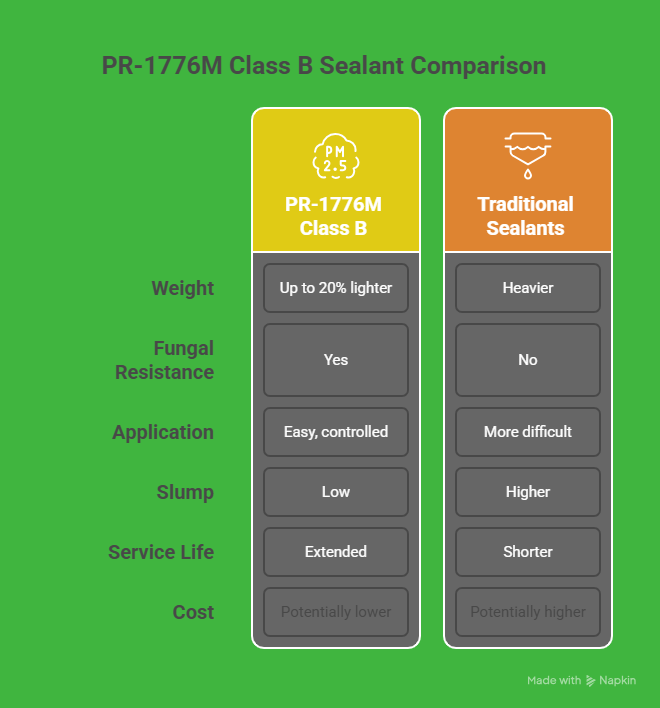
PR-1776M Class B is a low-density, high-temperature aircraft fuel tank sealant for structural fillet sealing, faying surface applications, and integral fuel tank work. It saves up to 20% weight per unit volume compared to traditional sealants, so you get performance without sacrificing durability.
The sealant is a medium-viscosity, thixotropic paste that allows for clean, controlled application to faying surfaces and fillets. It has a low slump (as low as 0.10 in for B-6) and can be applied by extrusion or with a spatula, allowing you to place it precisely on vertical or overhead surfaces.
PR-1776M Class B is formulated on a Permapol P-5 modified polysulfide system that cures at room temperature into a resilient elastomer that adheres well to common aircraft substrates like aluminum, stainless steel, titanium, and epoxy primed surfaces. After curing, it can withstand fuel exposure (jet fuel and avgas) and limited contact with phosphate ester hydraulic fluids.
With a service temp range of -65°F to 250°F and limited excursions to 360°F, the sealant performs well across demanding mission profiles.
It has strong peel strength across multiple substrates, high elongation (up to 439% after fuel immersion), good low-temperature flexibility, and excellent resistance to water, alcohols, petroleum-based lubricants, and synthetic oils, so it’s a reliable choice for long-term structural sealing in humid, marine, or fuel-rich environments.
Available SKUs
PR1776MB2-6OZ (Semkit, Pack of 3) — GSIN: 11000125246597–Buy it here, now!
PR1776MB2PT (Pint) — GSIN: 11000125246598–Buy it here, now!
PR1826 Series: Fast-Cure Fuel Tank Sealants
PR-1826 is another fuel tank sealant that is designed specifically for fillet sealing of fuel tanks and general aircraft fuselage sealing.
Technical Overview
PPG PR-1826 Class B is a rapid-curing aircraft sealant engineered for minimal downtime, making it ideally suited for AOG maintenance events, shorter-duration inspection cycles like 100-hour inspections, and so on. Basically, any time there is an accelerated return-to-service requirement that does not jeopardize sealant quality.
Its epoxy-cured Permapol P-3 polythioether chemistry gets you to tack-free and durometer milestones fast, B-1/4 curing to 30A in as little as 1.5 hours at standard conditions.
Unlike polysulfide sealants, PR-1826 cures across the whole environmental envelope, at low temperatures and variable humidity. Great for field maintenance or unconditioned hangar operations where ecological controls are limited.
Once cured, the material is very flexible and elastomeric, even after exposure to jet fuel or avgas. It has high elongation (up to 350%) and maintains adhesion and mechanical integrity through thermal cycling, vibration, and hydrocarbon exposure. Flexibility down to –65°F (–54°C) with no cracking or adhesion loss so that it can withstand structural movement and extreme temperature fluctuations.
The sealant’s performance (fast cure, strong peel adhesion to aluminum, titanium, stainless steel, and treated substrates, and water resistance, petroleum-based fluids, synthetic lubricants, and hydraulic oils) makes PR-1826 the preferred choice when speed and reliability are equally important. Its non-nutrient, fungus-resistant formulation makes it even more durable in humid, tropical, or high moisture conditions.
Available SKUs
PR1828 Series: High-Temperature Fuel Tank Sealants
PR-1828 is closely related to the PR-1826 family of sealants in chemistry and application, but it is specifically formulated for higher sustained temperatures. It is a two-part, manganese-dioxide-cured polysulfide sealant designed for sealing integral fuel tanks where elevated thermal exposure is expected.
It is a widely used product specified for high-temperature climates, high fuel temperatures, or localized uses adjacent to engines, APU bays, or environmental control ducting.
Technical Overview
PR-1828 sealant is made to maintain elasticity, adhesion, and sealing integrity across a wide operating temperature range. Unlike standard fuel tank sealants that stiffen or lose resilience over time at higher operating temperatures, PR-1828 stays flexible and resists cracking or shrinkage under prolonged exposure to heat.
Thermal stability is critical for preventing micro-leaks, especially in aircraft that see frequent thermal cycling between ground operations and cruise.
Chemical Resistance for High-Performance Aircraft
The PR-1828 series is resistant to aviation fuels, fuel additives, oils, hydraulic fluids, and cleaning agents found in high-performance and military aircraft. The polysulfide chemistry prevents fuel swelling and chemical degradation over time, so the seal remains intact in tanks exposed to harsh operating conditions and extended service life.
PR-1828 Is Used on Transport Aircraft, Rotorcraft, and Military Platforms
PR-1828 sealants are used on commercial transport aircraft, rotorcraft and military aviation platforms where durability and temperature tolerance is critical. Typical applications include integral wing fuel tanks, fuselage tanks, access panels, seams and fastener sealing. Proven performance under heat, vibration and fuel exposure makes it a go-to choice for both OEM production and depot-level or field maintenance programs.
Available SKUs
PR-2001 Series: Black Fuel Tank Sealant for Visual Inspection Contrast
Technical Overview
The PR-2001 Series is a fast-curing, aircraft grade fuel tank sealant that provides both sealing performance and visual contrast during application and inspection. The black/white two-part system mixes to a uniform gray, making it easier for technicians to confirm thorough mixing and consistent application during critical fuel tank sealing operations PR-2001.
Unlike traditional polysulfide sealants, PR-2001 is an epoxy-cured Permapol formulation that adheres to properly prepared aircraft substrates and maintains elastomeric properties after exposure to jet fuel and aviation gasoline. The cured sealant forms a durable, low-shrinkage barrier that resists cracking, softening, and adhesion loss over a wide temperature range, including -80°F (-62°C).
PR-2001 is ideal for applications where visibility matters, such as fillet sealing and internal fuel tank work on transport aircraft, rotorcraft, and military platforms. The color contrast, combined with fast cure schedules and repairability, helps reduce rework and supports quality control during initial installation and maintenance.
PS-870 Series: Corrosion Inhibiting Fuel Tank Sealants
The PS-870 Series is a corrosion-inhibiting polysulfide fuel tank sealant designed to protect aluminum alloys and dissimilar metal interfaces found in aging aircraft structures. Formulated with soluble chromate corrosion inhibitors, PS-870 acts as a barrier against moisture intrusion and electrochemical corrosion mechanisms while maintaining adhesion and flexibility over time.
PS-870 Class B is a manganese dioxide-cured, two-part polysulfide compound with a low sag, thixotropic consistency that is well-suited for tooling, fillet sealing and extrusion gun application. Once cured, the sealant retains elastomeric properties after exposure to jet fuel, aviation gasoline, salt fog and cyclic temperature extremes from -65°F (-54°C) to 250°F (121°C) with intermittent excursions up to 275°F (135°C) PS-870.
Because of its corrosion-inhibiting characteristics, PS-870 is used in military fuel systems, depot-level maintenance, and sustainment programs where corrosion prevention is a long-term structural concern. It is especially effective on older airframes or corrosion-prone fuel bays, helping extend service life while supporting compliance.
PS-890 Series: General Purpose, OEM-Approved Fuel Tank Sealants
The PS-890 Series is one of the most widely used and OEM-approved PRC-DeSoto fuel tank sealant families, used across commercial, military, and business aviation platforms. Designed for integral fuel tank sealing, PS-890 provides a balanced combination of durability, flexibility, and chemical resistance for both production and in-service maintenance environments.
PS-890 sealants exhibit excellent resistance to vibration, wide temperature swings and prolonged exposure to jet fuel, aviation gasoline, hydraulic fluids, lubricating oils and water. Once cured, the material maintains strong elastomeric properties, peel strength, along with adhesion across common aircraft substrates, including aluminum, stainless steel, titanium, and treated composite surfaces.
To support a wide range of application requirements, PS-890 is available in brushable Class A formulations for fay sealing and thin-film applications, and tooling Class B versions for fillets, seams, and gap filling. This versatility makes PS-890 a go-to, general-purpose sealant for fuel tanks, fuselage joints, and wet-installed structures where long-term sealing reliability is critical.
Available SKUs
Comparison Chart: Cure Times, Class, Packaging, and Use Cases
PR-1440 Class B and PR-1750 Class A are both polysulfide fuel tank sealants that exhibit good adhesion to aircraft substrates after immersion in Jet Reference Fluid (JRF), but PR-1750 has slightly higher peel strength on most substrates. PR-1440 is for fillet sealing with low-sag paste application, and PR-1750 is for brush sealing of fasteners up to 25 mils thick. Both pass 100% cohesion in peel tests post-7 days at JRF 140°F/60°C; PR-1750 averages 35 pli (156 N/25mm), and PR-1440 averages 30 pli (133 N/25mm).
PR-1826 vs. PR-1828: Fast Cure vs. High-Temperature
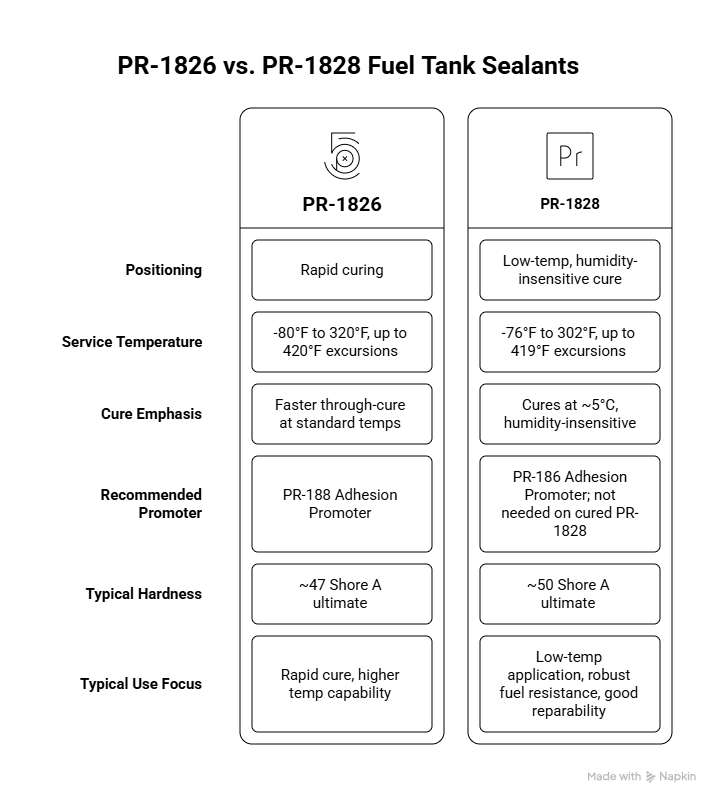
PR-1826 Class B cures fast (tack-free in 1-2 hours at 77°F) and has a higher service temperature up to 320°F continuous/420°F intermittent, faster than PR-1828 for fillet sealing. PR-1828 Class B has high-temperature performance to 302°F continuous/419°F intermittent with a slower cure (tack-free in 1-10 hours) and lower-temperature curing down to 41°F. Both polythioether sealants have good adhesion (40-50 pli) but require promoters such as PR-188 or PR-186 as additives.
PS-890 vs. PS-870: General Purpose vs. Corrosion-Inhibiting
PS-890 Class A is a general-purpose polysulfide fuel tank sealant for brush/fay sealing with standard adhesion and fuel resistance, while PS-870 Class B is chromate-containing for corrosion inhibition on aluminum/dissimilar metals.
PS-870 passes 670-hour salt spray tests with no corrosion, unlike the general corrosion resistance noted for PS-890. Both handle service from -65°F to 250°F, but PS-870 prioritizes barrier protection over extended fuel exposure. Both of these are designed to withstand fuel tank conditions and are intended for standard adhesion.
Procurement Guidance for Government and Military Buyers
One of the biggest challenges for government and military buyers is sourcing consumables for high-ops-tempo maintenance operations and ensuring they come from approved sources without the contracting hoops you are so familiar with.
We have helped ease that pain by loading hundreds of products on GSA Advantage. When you find products on GSA Advantage, you know the seller is already vetted and approved. Also, you can clearly see any specific identifiers that you need to meet, including Small Business, HUBZone, or Native American-owned, which we are all three.
How to Order Through GSA Advantage
Throughout this article, you have seen tables with SKUs, descriptions, and links to GSA Advantage listings. These are the live links to the products we carry mentioned in this article. Just follow the links to the specific product and quantity you need, and purchase it through GSA Advantage!
Why Buy From Greenwood Aerospace
Greenwood Aerospace is a small business based in central Northern Oklahoma. We have been in business for over 4 decades and have worked with every branch of the military and numerous federal agencies.
Greenwood Aerospace is ITAR-registered with the U.S. Department of State, which enables us to support defense contractors and military programs involving ITAR-controlled exports. Here are our key certifications and identifiers:
UEI: KVSUYYSJS174
DUNS: 604006874
CAGE Code: 2Y735
ITAR DDTC Export Compliant
AS9120B QMS Certified
NAICS: 488190, 336413, 332722, 336411, 336413, 481212, 532411
If you’d like help confirming availability, placing a large order, or expediting delivery, email gsasales@greenwood.aero or call 580-865-6000 / 833-GSA-EBUY (833-472-3289).
.svg)