
Flamemaster Polysulfide Sealants for Fuel Tank Structural Repairs on GSA Advantage
Today, our focus is on fuel tank structural sealants and small-batch repair applications. This is the Flamemaster polysulfide line of structural sealants, the right choice for military fuel cell teams.
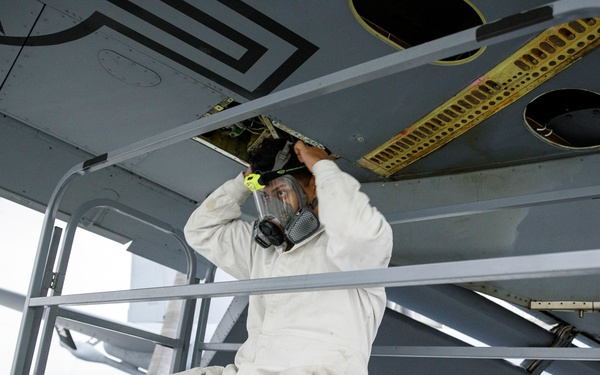
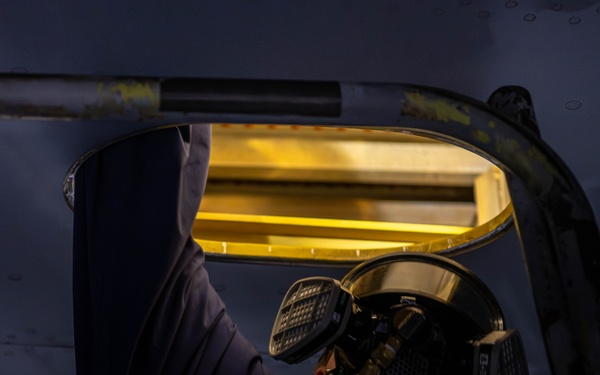
Aircraft fuel tanks are integral to aircraft structure and serve many other important purposes, mainly as heat sinks for hot fluid lines that cool the fluids. It's very important that these maintain the appropriate sealants and other consumables.
Greenwood Aerospace sits at the intersection of government procurement, aircraft maintenance parts, and consumables. We are the experts in sourcing anything you need, as far as sealants, epoxies, top coats, paints, primers, corrosion inhibitors, and thousands of other items. Now let's get started.

Product Overview: Flamemaster Chemseal Fuel Tank Sealant
Chemseal CS-Series sealants are polyfluorosulfide sealants composed of two parts. These are engineered to preserve fuel system integrity within aluminum aircraft structures, which are commonly used as fuel tanks. These materials cure at room temperature and form an elastomeric seal that bonds tightly to all standard aircraft substrates used to house fuel. It does this while maintaining flexibility under vibration and excessive thermal cycling.
In service, they function as fuel tank sealants for sealing integral fuel tanks, ribs, stringers, and access structures, and are used during initial production and throughout repair and MROs.
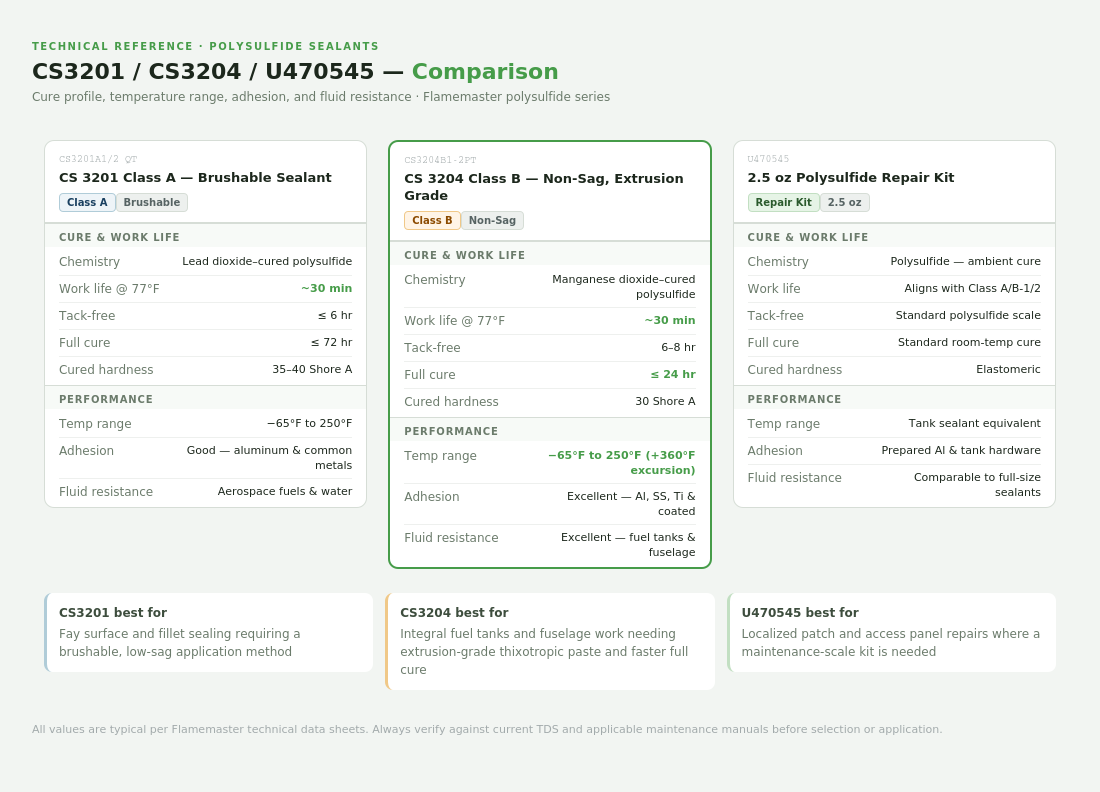
In modern airframe designs, CS3201 and 3204 are fully suitable for integral fuel tanks and can also be used for pressurized cabins, including zones in continuous contact with jet fuels, lubricating oils, and hydraulic fluids. Once cured, polysulfide remains fuel-resistant and resilient for years, allowing the seal to withstand prolonged exposure to common fuels and water without embrittlement or loss of adhesion.
ChemSeal CS3201 Class A and CS3204 Class B sealants are direct continuations of established polysulfide chemistries dating back to legacy sealants like the ProSeal product families, which have been used for decades. These maintain compatibility with existing aerospace primers, adhesion promoters, corrosion inhibitors, and repair practices, and align with the performance standards of AMS-S-7124 and AMS-S-8802.
Technical Properties: Cures At Room Temperature And Low Temperatures
Mixing And Handling: Chemseal Ratios And Scale Use
Chemseal CS series sealants must be mixed at the exact base-to-curing agent ratios specified in the technical data to ensure proper cure and fuel system performance. CS-3201A1-2QT, which is a Class A brushable sealant, uses a 100:7.5 by weight mix ratio.
CS-3204B1-2PT, a Class B non-sag extrusion-grade sealant, uses a 100:10 by weight ratio. Technicians should always weigh components on an accurate grand scale, dispensing partial batches onto disposable trays and maintaining specified ratios at all times.
For small repairs, pre-measured kits like U470545 minimize mixing errors and are well-suited for limited-material repairs. All mixing must be done with clean tools. Always avoid moisture, oil, and other shop contaminants and work under suitable temperature and humidity so that working time and cure profiles match the data sheets. Class B should be applied by extrusion gun, and Class A with a brush or spatula.
Application Procedures For Fuel Tank Structural Repairs
Always begin by thoroughly preparing the substrate, whether it's aluminum skins, ribs, or any mating metals. Remove old sealant, corrosion, oxidation, and a braid bond area with approved media to promote mechanical keying.
For structural rib-to-skin joints, you'll need to apply a continuous, non-gap bead of CS3204B1-2 among fastener rows and faying interfaces. Do this by using an extrusion gun to control the bead size and placement. Use CS3201A1/2 as a brushable coating on face surfaces and for forming smooth fillets at internal corners, fastener lines, and stiffener termination points.
Rivets and fasteners should be wet-installed into uncured sealant following the specified sequence in the aircraft tech data. Squeeze out forms around the shank and head. This provides a fully sealed, tangle-free tank, and you'll want to inspect bond lines and squeeze out during the room-temperature cure to confirm full coverage, no voids, and appropriate tooling. Once cured, these sealants are suitable for areas that are continuously exposed to aircraft fuels and other lubricants, such as fuel cells.
Small-Batch Repair Workflow (Room Temperature Curing)
For small and localized repairs, inspection panel resealing, and minor patchwork, a better option is to use a pre-measured kit like the U470545 in a 2.5 oz pack to simplify ratio control and reduce waste. These are pre-measured, so mix only the volume needed for the material's short work life, especially when drawing from a larger pint or quart kit, and discard any excess once it begins to thicken.
Apply any slosh coats sparingly, and only when explicitly specified by the OEM, the Structural Repair Manual, or technical guidance for military aircraft. Do this to avoid a build-up that could trap contaminants or cause cracking. If cured, the sealant must be removed. Use localized mechanical methods, such as plastic scrapers and careful abrasion, and approved chemical removers to protect underlying structure and finishes.
Packaging And Kit Options For Small Batch Fuel Tank Repair
Chemseal-style polysulfide sealants come in multiple package sizes to match the scope of fuel tank work, from minor access panel reseals to full structural maintenance. The 2.5 oz U470545 kit (pack of 3) is for localized repairs, small patch work, and single inspection panel reseals where only a few grams of material are required. It is easy to apply thanks to the kit's small, pre-mixed nature.
Pint kits like CS3204B1-2PT (pack of 5) are for larger structural rib-to-skin joints and extended bead runs in a single tank, while quart kits like CS3201A1/2 QT (pack of 10) are for broad fay surface coating and extensive fillet work. For squadron- or depot-level operations, larger bulk packaging and multiple-kit cases provide economical coverage across multiple aircraft and repeated tank entries. Class A brushable material is for coating and fillets, while Class B non-sag material is for extrusion beads; choose kit size based on whether the task is a single-tank repair, an access panel reseal, or recurring multi-aircraft structural maintenance.
Greenwood Aerospace Is Your Procurement Partner
As a U.S. Department of State ITAR-registered company, Greenwood Aerospace is fully certified to support defense and government contracting requirements. We maintain an AS9120B Quality Management System and ITAR DDTC Export Compliance.
GSA Multiple Award Schedule (MAS) Contract: 47QSMS25D00B8
Company Identifiers
UEI: KVSUYYSJS174
DUNS: 604006874
Cage Code: 2Y735
NAICS: 488190, 336413, 332722, 336411, 481212, 532411
Need help with product availability, bulk orders, or expedited shipping? Contact gsasales@greenwood.aero or call 580-865-6000 / 833-GSA-EBUY (833-472-3289).
.svg)

.jpg)


