

Aerospace Potting and Encapsulation for Electrical Protection
Modern military aircraft and those used by the federal government are loaded with electronic assemblies throughout their structures. These are radomes, these are electrical sensors, and "eyes." These are cameras, these are forward-looking infrared pods. On tactical military aircraft, hard points. All of these must be inspected regularly to ensure proper operation. And all of them must be properly sealed off from the environment.
The components inside are very sensitive to moisture, vibration, thermal cycling, and chemical exposure, which can damage or destroy them.
In this article, we're taking a look at potting encapsulation and electrical protection in aircraft, as well as the epoxies and sealants used to achieve them. We'll also discuss how Greenwood Aerospace can help you procure them in bulk if needed, or on a smaller scale. Whatever your scale is, we can help you. And, if you're ready to buy these products, check out our listings below!
Purpose, Scope, and Use Cases in Aerospace Systems
Potting and encapsulation in aircraft refer to the process of filling or surrounding electrical components with protective compounds. These compounds are used to insulate, seal, and even mechanically stabilize them. Electrical protection ensures that electronic assemblies remain operational under extreme environmental and operational stresses encountered in military operations.
These processes protect electronics from moisture and condensation, vibration and shock, heat and elevated temperature exposure, corrosion, oxidation, chemical exposures such as jet fuel, AVGAS, hydraulic fluid, and other harsh chemicals, and, of course, thermal cycling and thermal shock.
Overview of Potting and Encapsulating Compounds
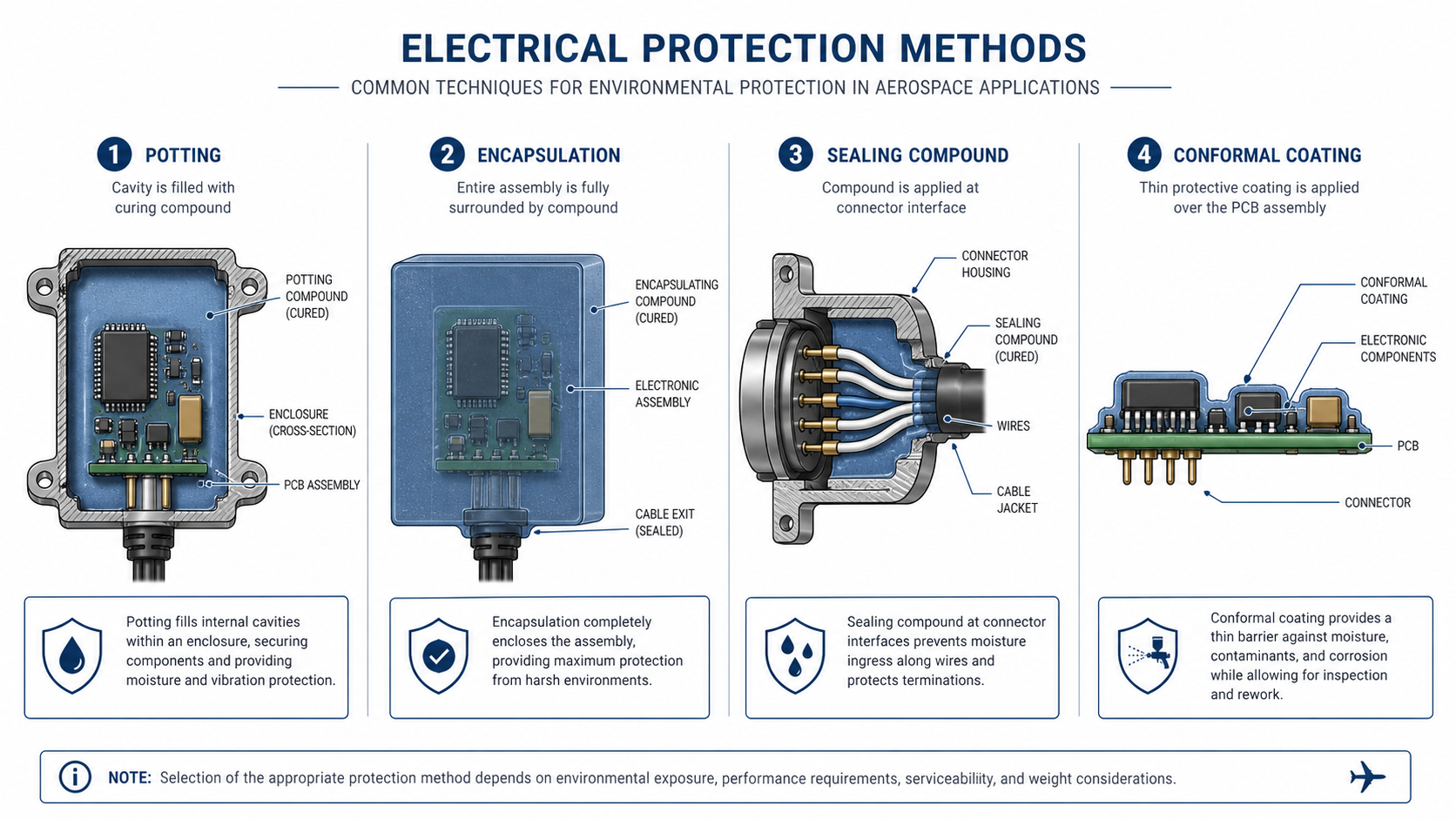
Potting compounds are liquid materials that are poured or injected into housings to encapsulate components. Potting materials cure into solid or, in some cases, elastomeric masses that protect internal electronics.
Encapsulating compounds, on the other hand, serve a similar function but may fully enclose an electronic assembly rather than merely fill the cavities.
Important distinct factors to distinguish are:
• Potting = filling a cavity around components
• Encapsulation = fully surrounding an assembly
• Sealing compound use = sealing connectors or interfaces
• Conformal coating = thin protective layers over circuit boards
Two things that they do similarly are:
• Potting and encapsulation protect electrical components, electronic assemblies, circuit boards, and electrical connectors, which are used all over military aircraft.
In aerospace systems, cleanliness and low outgassing are important metrics. Materials must meet strict standards to prevent contamination of the optical system sensors and other sealed avionics systems on the aircraft where they are used.
Thermal and Electrical Performance Fundamentals
Many electrical parts and electronic components last longer, perform better, and withstand the stresses and strains of heavy use with fewer complaints when potted or encapsulated in a polymer. These two terms are often used interchangeably, but they don't quite mean the same thing. Let's talk about the fundamental thermo-electrical performance.
Thermal properties and electrical insulation performance are key factors that determine whether a potting material is suitable for aerospace use.
Thermal conductivity determines how effectively heat is dissipated from these electronic assemblies. Heat kills electronics, period.
So, standard potting systems provide insulation, but high-thermal-conductivity systems are required for power electronics and inverter systems. Glass Transition temperatures (Tg) are critical. A low-Tg system remains flexible at low temperatures but may lack high-temperature stability. A high-Tg system provides structural rigidity at higher temperatures but may be more brittle under vibration, which is important in aerospace and aviation.
Since service ranges routinely span from sub-zero flight conditions to elevated inlet temperatures, effective thermal management must ensure heat dissipation and prevention to prevent long-term degradation of the electronics.
Potting Materials by Chemistry and Performance Profile
Different chemistries are used to meet different requirements in aerospace and aviation maintenance.
Material selection depends on a few factors:
• Service range
• Cure behavior
• Mix ratio
• Viscosity
• Vacuum processing
Some of the critical performance metrics include:
• Flame retardancy
• Flame retardants compliance
• Outgassing volume (i.e., low is better)
• High temperature resistance
• Compatibility
These common fluids must withstand prolonged exposure to fuel vapors, hydraulic fluids, and other aggressive chemicals commonly used in aerospace.
Epoxy Potting Compounds for Structural and High-Temperature Systems
Epoxy potting systems are widely used in structural and high-temperature aviation applications. They provide good adhesion, excellent mechanical strength, dimensional stability, and strong dielectric properties. Epoxies are selected for important applications where load-bearing, rigid encapsulation is required. However, they can and occasionally do exhibit brittle behavior under high vibration and thermal expansion, so careful CT matching (coefficient of thermal expansion) is required.
.jpg)
Urethane and Flexible Potting Systems
Polyurethane potting materials are among the most widely used and universally accepted materials for vibration-prone areas and sensitive components, including thermal targeting, FliR pods, sensor eyes, and other optical and sensory suites.
The benefits of polyurethane potting systems are:
- Low modulus flexibility
- Impact resistance
- Vibration absorption
Urethanes offer a good balance of mechanical strength and flexibility, making them a good option for wiring harnesses and sensor encapsulation.
The drawback is that they are more moisture-sensitive during curing and require strict mix ratios.
Silicone Potting Compounds and Low Tg Systems
Silicone potting systems are best for components that are subjected to extreme thermal cycling. These systems offer:
- Low Tg performance
- Low modulus flexibility
- Resistance to thermal shock
- Stability at cryogenic and elevated temperatures
Silicone aids heat dissipation, making silicone potting compounds ideal for power electronics. When critical applications require fully cured silicone compounds with excellent adhesion, silicone is your go-to.
Electrical Potting for Power Electronics and Thermal Management
Electrical potting for power electronics focuses on both insulation and heat control. The requirements for this are:
• High dielectric strength
• Insulation resistance
• High thermal conductivity
• Heat dissipation efficiency
Thermally conductive fillers are incorporated to improve thermal management. This is usually used in battery packs, electrical inverter systems, and sometimes even motor drives. The design has to address:
• Thermal path optimization
• EMI mitigation
• Proper grounding
Electrical potting protects electronics from these prolonged exposures to vibration, heat, and environmental stresses.
.jpg)
Testing, Qualification, and Aerospace Standards
Qualification testing validates the long-term performance of potting materials. The standards usually include:
• Thermal cycling and thermal shock
• Vibration and resistance
• Flammability compliance and flame retardancy
• Outgassing
• Dielectric breakdown
It also tests insulation resistance measurements. Environmental exposure testing also has to determine how well it handles jet fuel, aviation gas, hydraulic oils, and other caustic chemicals.
Repair, Rework, and Service Range Maintenance
Potting is usually considered a permanent solution, but this is also a generality. In real-world operations, there are exceptions to many rules, and this is one of them.
The process of de-potting an item is not easy and can create conditions that lead to damage. You cannot see what lies beneath the potting material, so the removal process must be done methodically and in accordance with established guidelines.
De-potting is not just digging out cured material. Aerospace potting compounds (epoxies and filled systems) are designed for adhesion, thermal stability, and environmental resistance. Removing them can introduce secondary damage if not managed properly.
Maintenance planning should cover:
- Engineering approval before material removal
- Identification of potting chemistry (epoxy, urethane, silicone)
- Use of mechanical, thermal, or chemical softening methods appropriate to the material
- Protection of circuit boards, conductors, and electrical connectors during removal
- Avoid overheating adjacent components during localized thermal softening
Thermal removal must stay below component damage thresholds. Mechanical removal must not introduce microcracks or damage to the conductor. Chemical stripping agents must be compatible with substrates and not leave conductive residues.
All de-potting activities should be documented in the work order and reviewed under configuration control.
Inspection cycles do vary from item to item, so make sure to consult all applicable technical data and acceptable criteria for the component in question.
Supplier Selection and Implementation Roadmap
Choosing a supplier is often a matter of blind trust. You look up the potting and encapsulation materials that fit your temperature range or are formulated for your MDS, and then fire off a supply request into the void.
We at Greenwood Aerospace aren’t fans of that. We understand the human element involved and recognize that your support team is a valuable component of trust. When it comes to the consumables that keep your aircraft and support equipment operating as they should, you need to trust the professionals downstream in the supply chain.
We have been in business for over forty years and have worked with all branches of the military and numerous federal agencies.
Greenwood Aerospace partners with prime defense contractors to support military and government export programs. We are ITAR-registered, AS9120B-certified, and an approved GSA Schedule contractor.
GSA MAS Contract Number: 47QSMS25D00B8
Compliance & Registration
ITAR DDTC Export Compliant
Cage Code: 2Y735
UEI: KVSUYYSJS174
DUNS: 604006874
NAICS: 488190, 336413, 332722, 336411, 481212, 532411
For large orders or expedited delivery, contact 580-865-6000, 833-GSA-EBUY (833-472-3289), or gsasales@greenwood.aero.
.svg)

.jpg)


